The Bottom Line
- Across Indonesia, Thailand, and Vietnam, Shopee + TikTok Shop combined for roughly RMB 56 billion in September 2026. The market is still growing double digits — but almost all of that growth comes from Thailand and Vietnam.
- Indonesia's market is basically flat year-on-year. It's not that nothing grew — Shopee's gains were offset by TikTok Shop's decline.
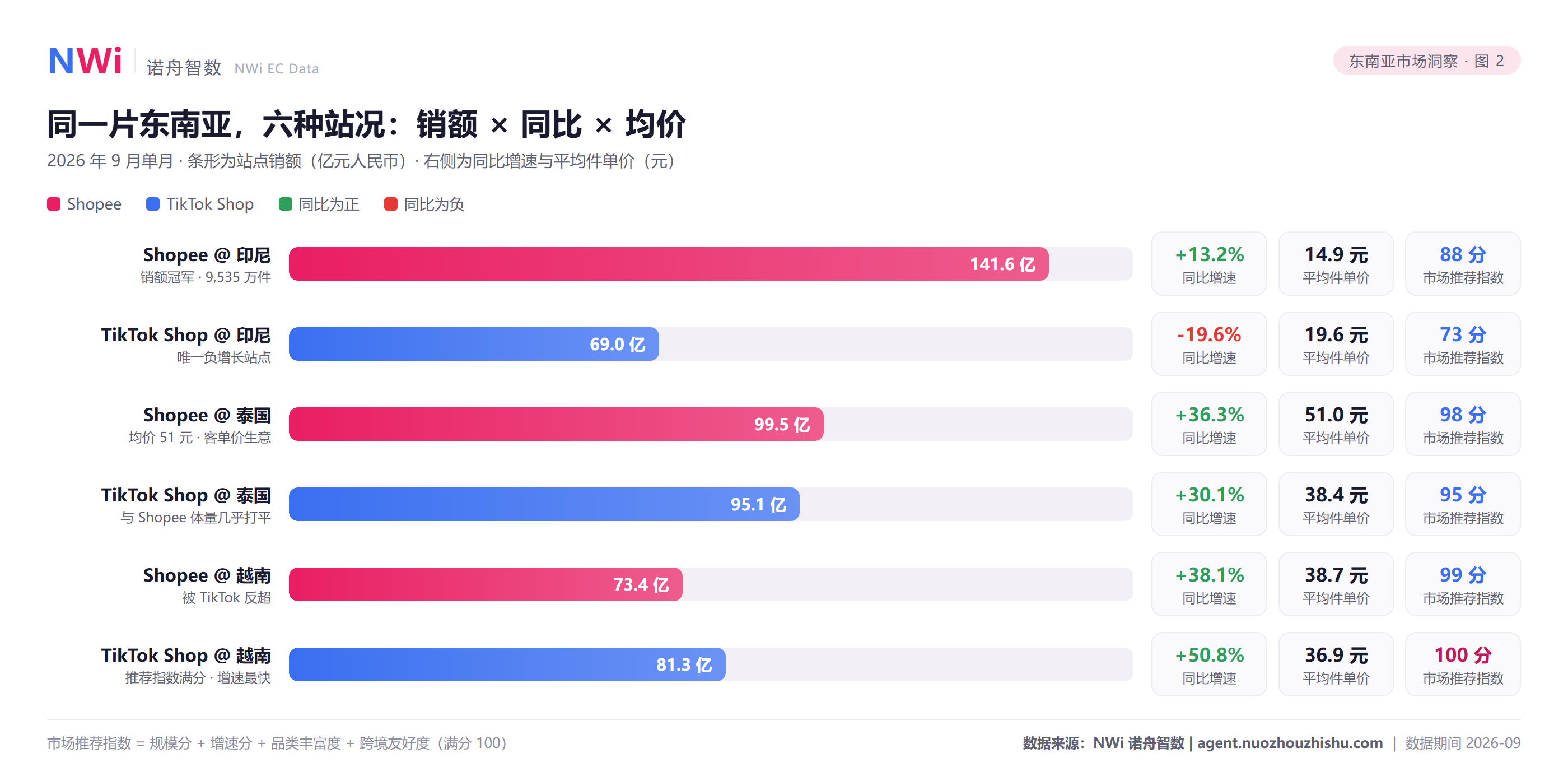
- Vietnam is the most certain growth market right now: Shopee +38% YoY, TikTok Shop +51% YoY. Both platforms surging at once is unique in Southeast Asia.
- Indonesia and Thailand/Vietnam are two different businesses: Indonesia runs on 15–20 RMB ticket sizes and piles up units; Thailand/Vietnam run on 37–51 RMB ticket sizes and make money on average order value. Applying one playbook to all three markets means you'll likely lose money in one of them.
1. The Big Picture: RMB 56B a Month, but the Growth Is "Structural"
Let's start with the total. In September 2026, Shopee and TikTok Shop combined across Indonesia, Thailand, and Vietnam:
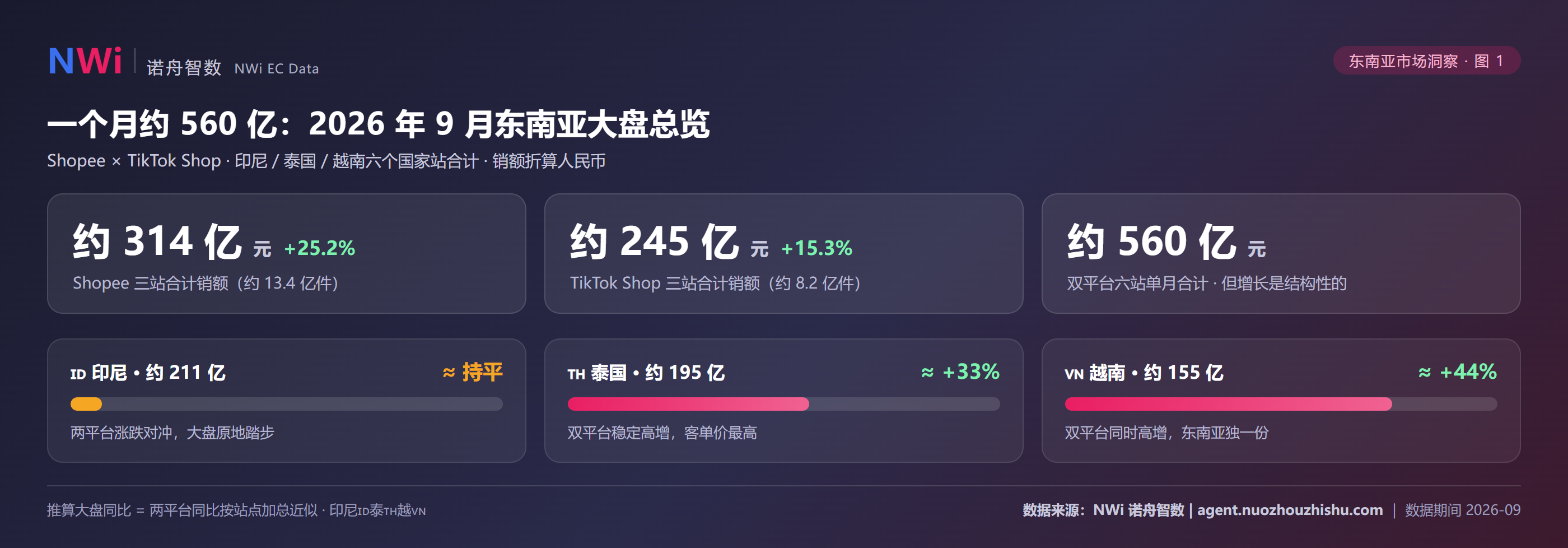
Looking at this table alone, you'd think "looks fine, everything is growing." Break it down by country and the picture changes immediately.
Aggregating the two platforms by country (YoY growth estimated per platform):
Indonesia, Southeast Asia's most populous country, still has the largest single-month market at RMB 21.1B — but overall growth has stalled. And beneath that flat line, internal divergence is intense — the subject of our next section.
2. Country Breakdown: One Southeast Asia, Three Businesses
Let's look at each country site (all data is September 2026, single month, sales converted to RMB):
Indonesia: the volume business
Indonesia's two platforms sell 130 million items a month combined, but average ticket is only 15–20 RMB. It's a classic "volume-driven" market — logistics rates, order structure, and purchasing power together pin the mainstream price band at 10–20 RMB. You're not competing on brand premium here; you're competing on every cent of supply chain cost and fulfillment efficiency.
And a counterintuitive fact: Indonesia has 2.6× the active sellers of Thailand (1.24M vs 510K), yet ranks last in market growth. Supply is flooding in while demand growth has stopped — the competition is brutally real.
Thailand: the ticket-size business
Shopee Thailand's average ticket reaches RMB 51 — 3.4× Indonesia's. In other words, Thailand generated RMB 9.95B in sales with just 195M items — 15% of Indonesia's volume, 70% of its revenue.
Thai purchasing power is solid and customer acquisition isn't as cutthroat as Indonesia. If I had to sum it up in one word: "quiet." It lacks Vietnam's dramatic +50% growth, but both Shopee and TikTok Shop hold steady above +30%, and the two platforms are nearly equal in size (9.95B vs 9.51B) — the healthiest platform structure of the three markets.
Vietnam: the growth business
Vietnam is the brightest star in this month's data: Shopee +38.1%, TikTok Shop +50.8%, combined roughly +44% YoY. TikTok Shop's Vietnam sales (RMB 8.13B) have already overtaken Shopee (RMB 7.34B) — among the Southeast Asian sites we cover, Vietnam is the first major market where content commerce has overtaken shelf commerce.
As a side note, in our "Market Recommendation Index" (scale + growth + category richness + cross-border friendliness, max 100), TikTok Shop Vietnam scored 100 and Shopee Vietnam 99. Algorithms don't talk, but scores are honest.
3. Category Structure: Shelf Commerce and Content Commerce Sell Different Southeast Asias
Still using Indonesia, here's the L1 category structure of Shopee vs TikTok Shop:
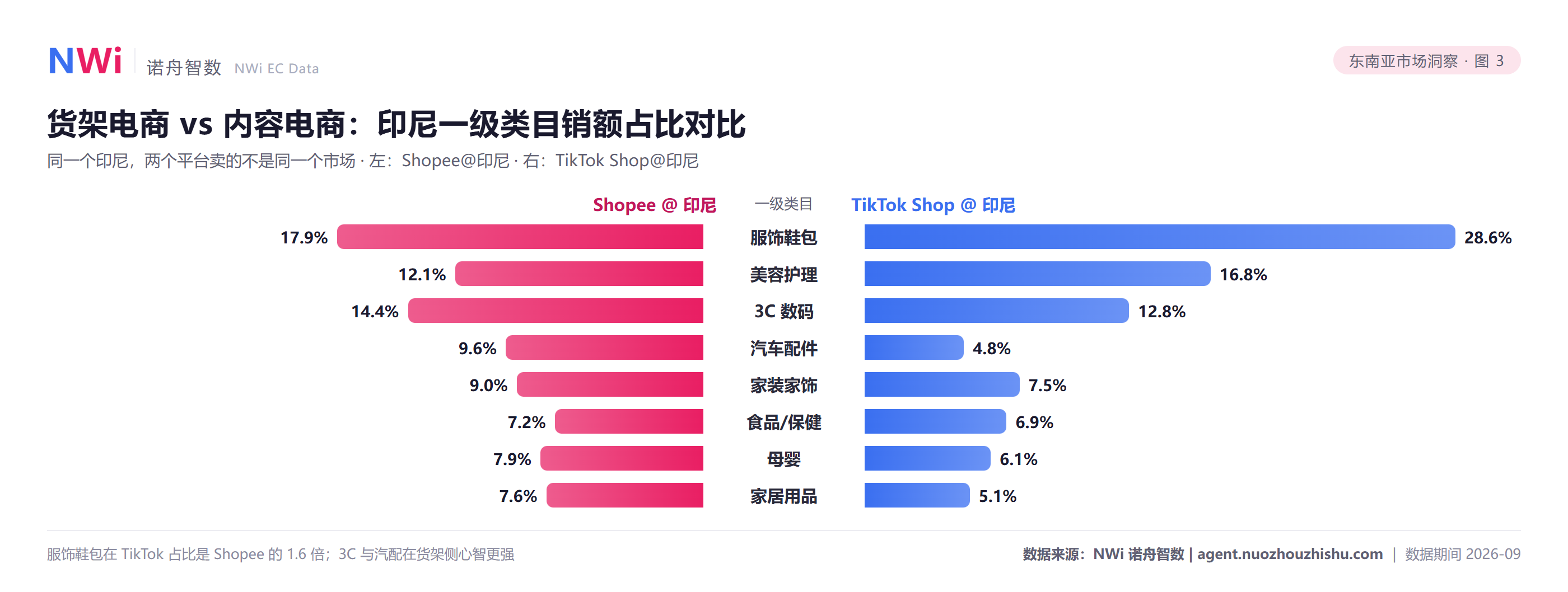
Two details worth chewing on:
First, apparel/shoes/bags take 28.6% of TikTok Shop's mix — 1.6× Shopee's 17.9%. Content commerce naturally amplifies "high-visual, low-decision-cost, impulse-buy" categories — clothing is the classic case. On Shopee, categories with "clear parameter needs" like 3C and auto parts hold visibly larger shares; the shelf search logic is still at work. A rough but useful rule: if your product sells on looks and live-streamer storytelling, TikTok's structural bonus is bigger; if it sells on specs and price comparison, Shopee's user mindset fits better.
Second, Indonesia's "extreme low-price categories" move staggering volumes. Home goods sold 152M units in a month (avg ~RMB 6.6), beauty & personal care 106M units (avg ~RMB 15). In these categories, a RMB 0.5 cost difference is life or death — which is why Indonesia belongs to white-label products and factory stores, and why brand-building is exceptionally hard there.
4. An Outlier That Must Be Called Out: TikTok Shop Indonesia at -19.6%
Five of six sites are growing. Only TikTok Shop Indonesia is down -19.6% YoY, with sales falling from roughly RMB 8.6B to RMB 6.9B.
Honestly, with one month of data, I'm not going to render a verdict on this decline — it could be a post-campaign pullback, a category mix adjustment, or something deeper. But read together with "Shopee Indonesia +13.2%" and "Indonesia seller counts surging," we can at least draw a conservative conclusion: Indonesia's content-commerce supply-side dividend period is over. What follows is a competition on operational efficiency.
5. Three Actionable Judgments for Cross-Border Sellers
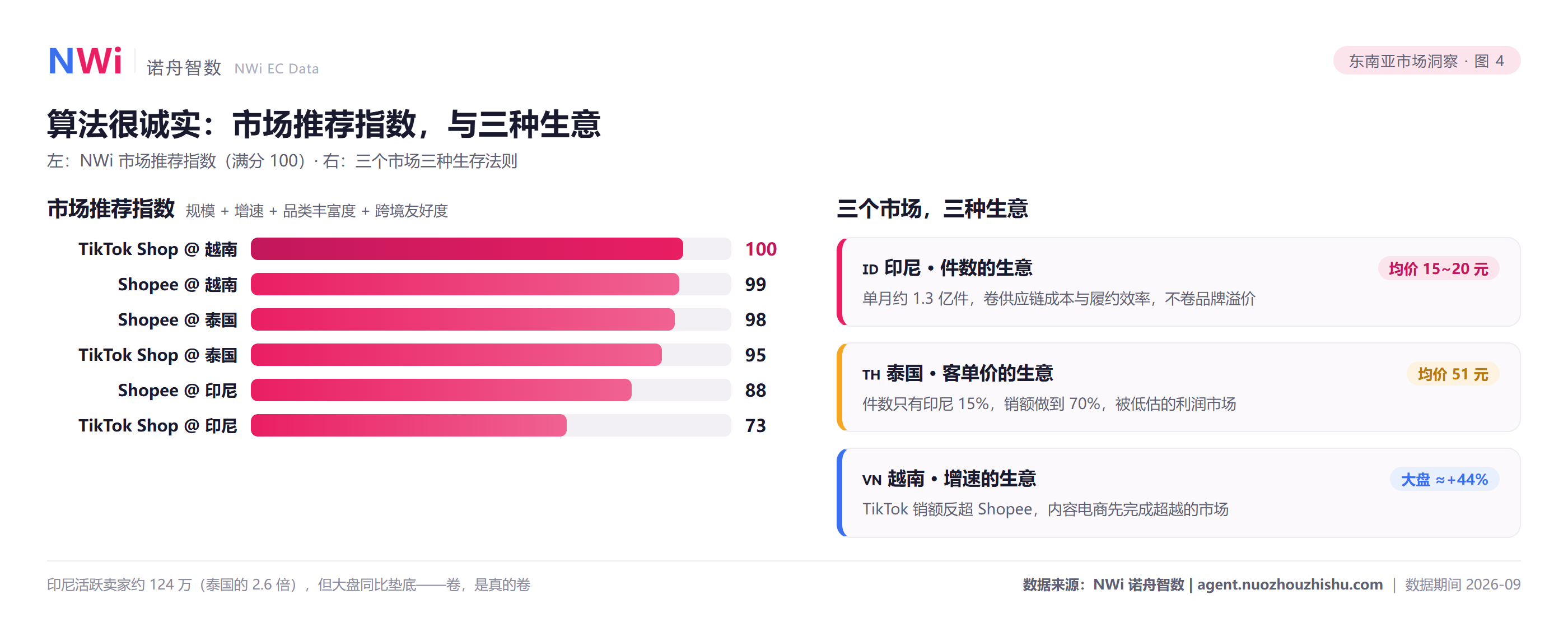
Finally, let's translate the data into decision language:
- Go heavy on Vietnam — and move fast. 40%+ dual-platform growth won't last forever, TikTok has already overtaken Shopee in Vietnam, and content-commerce playbooks (short-video seeding + livestream conversion) have their highest marginal return there right now. Playbooks and creative validated in other SEA markets will likely still capture a timing arbitrage in Vietnam.
- Change your play in Indonesia: compete on cost, not brand. In a market with RMB 15 ticket sizes and 1.24M sellers, the only survival rule is supply chain efficiency. If your cost structure can't support the sub-RMB 20 price band, Indonesia isn't your market — don't be fooled by the "270M population."
- Thailand is an underestimated profit market. RMB 51 ticket sizes mean a real middle-class consumption band exists here, with competition density only 40% of Indonesia's. It suits sellers with real product strength who want brand premium — especially home goods and personal care, categories that can differentiate on premium.